Introduction
The 90s were a wild time for action cinema, and few films captured that era's audacious spirit quite like Face/Off. With two of Hollywood's biggest stars, Nicolas Cage and John Travolta, at the peak of their powers, audiences were primed for a collision of epic proportions. What they got was not just a high-octane thrill ride, but a surprisingly thoughtful exploration of identity, grief, and vengeance, all wrapped in John Woo's signature balletic violence. This isn't just another action flick; it's a deep dive into what happens when two sworn enemies literally wear each other's lives.
The Lead Dynamic & The Action
From the opening frame, the energy rarely taps the brakes, largely thanks to the electrifying performances of its leads. Nicolas Cage, as the unhinged terrorist Caster Troy, sets a tone of gleeful madness, while John Travolta's FBI agent Sean Archer carries the heavy burden of personal tragedy. The true genius, however, unfolds when they swap faces. John Travolta masterfully channels Nicolas Cage's manic energy, adopting a "Nicolas Cage twang" and embodying the villain he despises. Meanwhile, Nicolas Cage portrays Archer's internal conflict with raw intensity, a good guy forced to act bad, visibly uncomfortable in his new skin—even breaking down in tears during a jailhouse brawl.
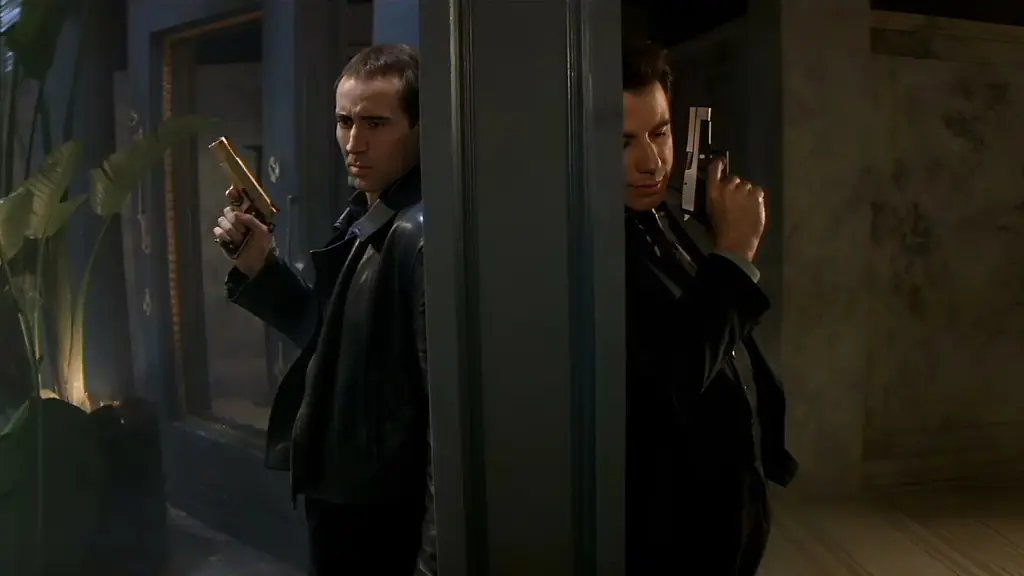
The action sequences are nothing short of iconic. While John Woo's previous work like "Broken Arrow" delivered thrills, Face/Off elevates the spectacle. Who can forget Caster Troy getting blasted by a jet engine, or the sheer audacity of the mirror scene where both men aim their guns at the reflection of their nemesis? These aren't just explosions; they're moments charged with emotional weight, a testament to the film's surprising depth. Even a seemingly simple act, like Caster Troy (as Archer) dragging a man out of a car and kicking him in the balls, becomes a memorable "dad moment" that resonates with a twisted sense of justice.
Cameos, Nostalgia & Narrative Stakes
Beyond the visceral action, Face/Off weaves a compelling narrative that constantly raises the stakes. The face-swapping procedure itself is hailed as "the greatest plot device," allowing for a unique exploration of identity. Both Archer and Troy are forced to live in the other's world, gaining an intimate, often painful, look into their enemy's life. Archer, disguised as Troy, witnesses the consequences of Troy's threats to Gina Gershon's character, Sasha, and the emotional toll on his own wife, Joan Allen, at their dead son's grave. These moments humanize the villains and add layers to the hero's quest.
However, not all narrative choices land perfectly. The magnetic super-prison, while visually striking and featuring a young Nick Cassavetes and Harve Presnell, feels like a leap of faith even in a world where faces can be swapped. It's a detail that, for some, stretches credulity more than the central premise itself. The film's pacing, particularly in its final third act, can also feel a little drawn out once the boat chase sequences begin, though it quickly recovers for a satisfying conclusion.
Tone, Direction & Creative Freedom
John Woo's direction is unmistakable, blending his signature slow-motion gunfights with moments of profound emotional resonance. The film embraces its outlandish premise with a confidence that suggests immense creative freedom. It's a movie that knows exactly what it is: a wild, over-the-top action thriller with a surprising amount of heart. The tone shifts seamlessly from explosive chaos to quiet, introspective moments, often within the same scene. This balance prevents the film from becoming mere spectacle, grounding the fantastical elements in genuine human emotion. The director's ability to extract such nuanced performances from his leads, especially when they are essentially playing each other, is a testament to his vision.
The Final Verdict
Face/Off stands as a testament to 90s action cinema, a film that dared to be bold, bizarre, and emotionally resonant all at once. It's a solid John Woo movie, far more than just its action set pieces. The unexpected emotional depth, coupled with the unforgettable performances of Nicolas Cage and John Travolta, makes it a truly unique cinematic experience. While a few plot points might require a generous suspension of disbelief, and the ending's adoption subplot feels a tad abrupt, these are minor quibbles in an otherwise exhilarating ride. This is a film that not only holds up but gains appreciation with each rewatch, solidifying its place as a must-own for any action fan.
What Worked
- Electrifying performances from Nicolas Cage and John Travolta.
- Surprisingly deep emotional conflict and character exploration.
- Memorable, over-the-top action sequences and shootouts.
- John Woo's signature stylish direction.
- A truly unique and engaging premise.
What Didn't Work
- Some plot devices, like the magnetic prison, strain belief.
- The third act action can feel a bit drawn out.
- Minor inconsistencies in the face-swapping aftermath.
- The ending's adoption subplot feels rushed and odd.