
Introduction
When a new Quentin Tarantino film hits the screens, it's an event. Audiences brace themselves for a cinematic "party," and The Hateful Eight was no exception. With trailers deliberately vague, moviegoers entered the theater with minimal information, ready to be swept into whatever wild ride Tarantino had crafted. What unfolded was a snow-swept, cabin-fever mystery that felt both familiar and uniquely his own.
The Lead Dynamic & The Action
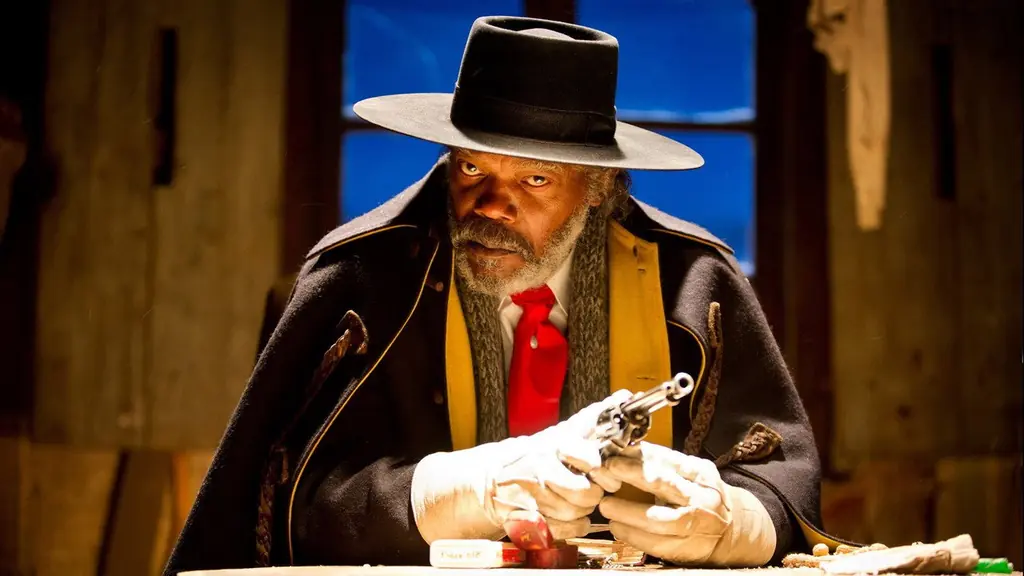
The film plunges viewers into a desolate Wyoming winter, where bounty hunter Kurt Russell is transporting his prisoner, the notorious Daisy Domergue (Jennifer Jason Leigh), to the hangman. Along the way, he encounters another bounty hunter, Major Marquis Warren (Samuel L. Jackson). A raging blizzard forces them, along with a motley crew of strangers, to take refuge in Minnie's Haberdashery. It's here that the film truly ignites, transforming into a tense, Tarantino-esque Western version of Clue.
The performances are nothing short of phenomenal. Samuel L. Jackson absolutely crushes it, commanding the screen with every line, a welcome return to the forefront of a Tarantino narrative. Kurt Russell delivers another great performance, embodying the gruff, determined bounty hunter. Even Jennifer Jason Leigh, as the captive, manages to be a standout, her presence unsettling and captivating. The ensemble cast, including Walton Goggins, Demián Bichir, Tim Roth, Michael Madsen, and Bruce Dern, all contribute stellar work. There's a particular scene where Bruce Dern looks utterly horrified, eliciting a genuine sense of pity from the audience. Tarantino consistently pulls great performances from his actors, a testament to his unique directorial style.

Cameos, Nostalgia & Narrative Stakes
Much like his earlier work, particularly Pulp Fiction, Tarantino proves he can hold an audience's interest with nothing more than two people talking. The Hateful Eight is brimming with interesting, tension-building dialogue that keeps viewers on edge. The "who done it" mystery at its core elevates this tension, making every conversation a potential clue. However, this central mystery also presents the film's most significant flaw. The fun of narrowing down suspects and piecing together the puzzle is cut short when the "beans are just spilled" too soon. The revelation feels premature, and what was once a thrilling intellectual exercise gives way to the inevitable "Tarantino Carnage" of the final act. While the carnage is expected, the abrupt end to the mystery can leave some viewers feeling a bit deflated, wishing the suspense had lasted longer.
Tone, Direction & Creative Freedom
Quentin Tarantino's love for cinema shines through every frame of The Hateful Eight. Shot in glorious 70mm, the film evokes the grandeur of classic Hollywood, complete with an overture at the beginning and an intermission in its three-hour runtime. This commitment to an older format, while other directors rush to digital, speaks volumes about his dedication to the cinematic experience. His movies aren't just films; they are events that transport you back in time. The music, too, is a character in itself. The eerie, tension-building score is amazing, instantly memorable, and perfectly underscores the film's unsettling atmosphere. It's the kind of music that makes you look around suspiciously, wondering who among your own company is the culprit.
The Final Verdict
The Hateful Eight is an undeniably unique cinematic experience. While it might not immediately leap to the top of every fan's list alongside Kill Bill or Pulp Fiction, it's a film that grows on you, revealing its brilliance upon reflection. With great performances, exceptional acting, a truly cinematic experience, and dialogue that will undoubtedly be dissected in film schools for years to come, it's an "awesome-tacular" achievement. Despite its one notable flaw concerning the pacing of its central mystery, The Hateful Eight delivers a compelling, unforgettable ride that only Tarantino could orchestrate.
What Worked
- Exceptional ensemble performances, especially [[person:2231|Samuel L. Jackson]] and [[person:6856|Kurt Russell]].
- Sharp, tension-building dialogue that captivates.
- Stunning 70mm cinematography creates an immersive, classic cinematic experience.
- An "awesome-tacular" score that heightens the mystery and dread.
- A unique, engaging "who done it" premise in a Western setting.
What Didn't Work
- The central mystery's resolution feels premature, diminishing the "who done it" fun.
- The film's lengthy runtime, especially after the mystery is solved.
- Pacing shifts significantly once the core mystery is revealed.



