Introduction
The promise of a high-octane, darkly comedic caper often ignites a certain spark in moviegoers, and 30 Minutes or Less arrived with all the right ingredients to fan that flame. Helmed by Ruben Fleischer, the director who previously delivered the genre-bending hit Zombieland, and featuring the familiar, fast-talking presence of Jesse Eisenberg, anticipation was naturally high. The setup itself is pure, unadulterated chaos: a slacker pizza delivery driver finds himself with a bomb strapped to his chest, given a mere 10 hours to rob a bank for $100,000. It's a premise so ridiculously over-the-top, so inherently hilarious, that it practically screams "cinematic gold." The stage was set for a wild, laugh-out-loud ride where crime inevitably goes wrong, and the audience was ready to buckle up.
The Lead Dynamic & The Action
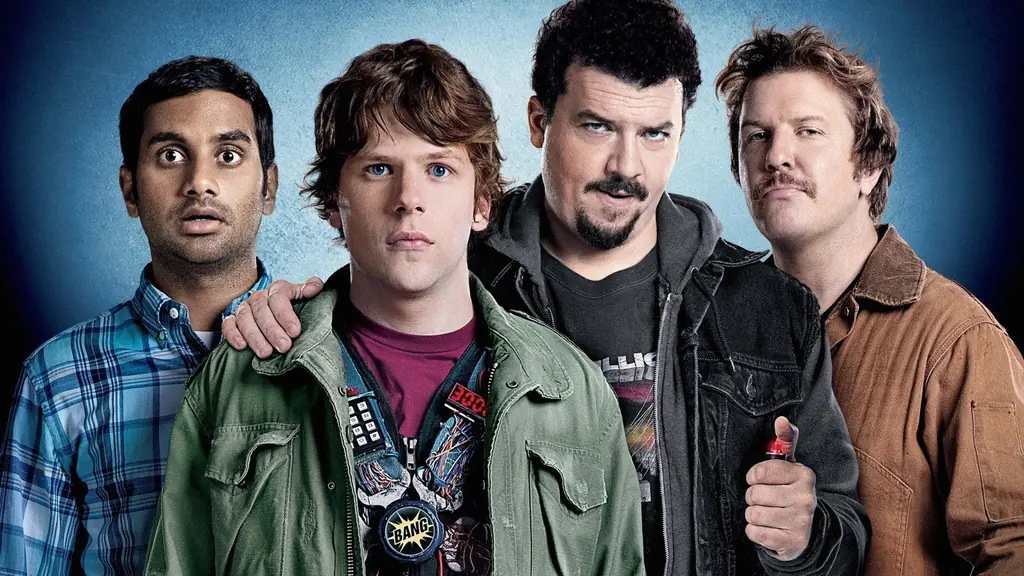
At the heart of this frantic scramble is Jesse Eisenberg's character, Nick, a pizza guy whose life is going nowhere fast. His reluctant accomplice is Chet, played by Aziz Ansari, a substitute teacher who, while perhaps slightly more ambitious, still finds himself in a dead-end career. Their dynamic is meant to be the comedic engine, two ordinary guys thrust into an extraordinary, life-threatening situation. While the film attempts to leverage their contrasting personalities for humor, the execution often falls flat. There's a particular vocal quality to Aziz Ansari's performance that, for some, proves more grating than endearing, a high-pitched delivery that can quickly wear thin.
Meanwhile, the architects of this explosive predicament are the bumbling, wannabe criminals Dwayne (played by Danny McBride) and Travis (Nick Swardson). Danny McBride brings his signature brand of crude, self-serving humor, but even his presence can't always elevate the material. The film's action sequences, however, occasionally hit their mark. The standout moment, the undisputed highlight of the entire experience, is a car chase sequence set to the iconic 80s anthem "The Heat Is On." This particular scene is a burst of pure, unadulterated fun, a moment where the film truly embraces its chaotic potential and delivers on the promise of its premise. It's a sequence so engaging, so perfectly scored, that it almost makes you forget the disjointed journey that led up to it.

Cameos, Nostalgia & Narrative Stakes
The plot of 30 Minutes or Less is driven by Dwayne's desperate desire to inherit his millionaire father's fortune, leading him to concoct the ill-fated plan to hire a hitman. This convoluted scheme, involving a bomb and an unwilling pizza delivery driver, is the narrative backbone. However, the film struggles significantly with its pacing and overall coherence. For much of its runtime, particularly in the first half, the story feels choppy and unfocused. It meanders, unsure of its own identity, leaving the audience wondering what kind of movie it truly wants to be. The narrative stakes, despite the literal ticking bomb, often feel surprisingly low, a consequence of the film's inability to consistently build tension or emotional investment.
The film attempts to balance its high-concept premise with comedic beats, but the balance is frequently off. While there are certainly funny one-liners and a few genuinely amusing scenes sprinkled throughout, they often feel isolated rather than contributing to a cohesive comedic whole. The overall impression is that of a script cobbled together from disparate ideas, lacking a clear, singular vision. It's as if the writers were struggling to connect various comedic scenarios, resulting in a narrative that feels less like a tightly woven story and more like a collection of sketches.
Tone, Direction & Creative Freedom
Ruben Fleischer's direction, while showing flashes of the energy seen in Zombieland, ultimately can't overcome the script's inherent weaknesses. The film's tone is inconsistent, veering between dark comedy, action, and buddy-cop antics without fully committing to any single lane. This lack of a clear tonal identity contributes heavily to the disjointed feel. The pacing is particularly problematic in the initial acts, where scenes often feel drawn out or abruptly cut, preventing any real momentum from building.
It's almost as if the creative team had a fantastic elevator pitch – "pizza guy, bomb, bank robbery" – but then struggled to flesh out the details into a compelling, feature-length narrative. The film only truly begins to find its rhythm in the second half, with about 40 minutes left on the clock. By then, however, it's often too little, too late. The initial choppiness and narrative uncertainty have already taken their toll, making it difficult for the audience to fully engage with the story, even as it attempts to pick up the pace. The film feels like a missed opportunity, a concept with immense potential that never quite reaches its full, explosive capabilities.
The Final Verdict
In the end, 30 Minutes or Less is a film that promises a lot but delivers only in sporadic bursts. It has its moments – a few genuinely funny lines, and that undeniably awesome car chase – but these bright spots are overshadowed by a narrative that is often boring, disjointed, and all over the place. Despite its high-stakes premise and the talent involved, the film struggles to leave a lasting impression. It's the kind of movie that, five hours after viewing, you'll likely struggle to recall with any significant detail. While it might offer a fleeting distraction for those seeking a chaotic, if uneven, action-comedy, it ultimately falls short of being truly memorable.
What Worked
- High-octane car chase sequence with an iconic 80s soundtrack.
- Intriguing, high-stakes premise.
- Sporadic moments of genuine comedic dialogue.
- Ruben Fleischer's signature action-comedy style shines in brief flashes.
What Didn't Work
- Disjointed and choppy narrative, especially in the first half.
- Struggles to establish a consistent tone or direction.
- Some character performances prove grating rather than endearing.
- Ultimately forgettable despite its explosive setup.